+44 (0) 20 7841 3888
 info@ccsg.co.uk
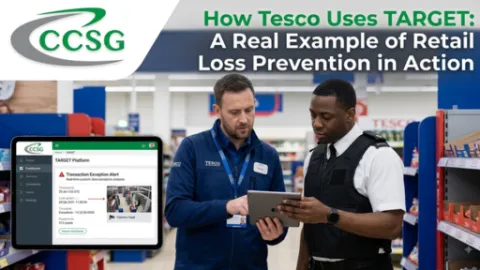
How Tesco Uses TARGET: A Real Example of Retail Loss Prevention in Action
Supermarkets do not lose money in one dramatic theft. They lose it in a thousand small ways, a refund that should not have gone through, a self checkout scan that never happened, a camera that was pointed the wrong way during the one moment it mattered. Tesco has worked with CCSG since 1997, and that long-running relationship provides a useful real-world example of how technology can support retail loss prevention uk at scale.
This article breaks down what actually happens inside that partnership, using CCSG's own TARGET platform documentation, and what any retailer, big or small, can learn from it.
What Is TARGET and Why Does Tesco Use It?
TARGET is CCSG's retail risk management platform, built to connect CCTV, point-of-sale data, and case management into one system instead of three disconnected ones. Tesco has worked with CCSG since 1997, making it one of the longest running enterprise deployments of any retail loss prevention system in the UK grocery sector.
The reason a business the size of Tesco needs this kind of platform comes down to scale. A single store can absorb a few unusual refunds without anyone noticing a pattern. Hundreds of stores generating thousands of transactions a day cannot be monitored by human eyes alone. TARGET exists to turn that scattered activity into something a loss prevention team can actually act on.
What makes TARGET relevant to a retailer at Tesco's scale:
- It is device agnostic, working across IP, analogue, and hybrid CCTV without forcing a full hardware replacement.
- It links video footage directly to point of sale transactions, so an unusual void or refund pulls the matching clip automatically.
- It has been refined over 25 years inside real enterprise retail environments, not built in a lab and tested only in demos.
How Does Retail Loss Prevention Work at Tesco's Scale?
Retail loss prevention strategies at supermarket level are not about catching one shoplifter. They are about spotting patterns across hundreds of locations before they become a serious drain on margin. According to CCSG's own breakdown of how TARGET works, the platform runs through five connected modules, each covering a different stage of an investigation.
TARGET brings detection, investigation, reporting, case management and CCTV monitoring into one connected workflow. TARGET Software detects the issue, TARGET Services matches it against known fraud patterns, TARGET Insight shows whether it is isolated or estate wide, TARGET CaseView tracks the case to resolution, and TARGET Discovery makes sure the cameras behind all of it were actually working.
That handoff between modules is the part most competing tools skip. A camera system alone tells you something happened. A till system alone tells you a transaction occurred. Neither on its own tells an investigator why a specific refund at a specific till at a specific time deserves a closer look. Combining them is what turns raw data into a usable case.
Which TARGET Modules Power Tesco's Loss Prevention Strategy?
Tesco's use case touches all five modules, but three of them do most of the heavy lifting for day to day supermarket loss prevention.
TARGET Software is the detection layer. It links live CCTV directly to till data, so when a cashier processes an odd refund or a self checkout flags unusual scanning behaviour, the matching video appears automatically instead of someone searching hours of footage by hand.
TARGET Services brings over 150 prebuilt operational risk blueprints, effectively ready made playbooks for known fraud types. For a business the size of Tesco, this means new stores and new staff are not starting from zero every time a fresh shrink pattern appears.
TARGET Insight rolls all of that case activity into one estate wide dashboard, which according to CCSG's detailed explanation of the platform, replaces the spreadsheets that regional teams would otherwise be piecing together manually.
A quick comparison of what each module solves:
|
Module |
Main Job |
Why It Matters for Supermarkets |
|
TARGET Software |
Real time fraud detection |
Cuts investigation time significantly by linking video to transactions |
|
TARGET Services |
Prebuilt fraud playbooks |
Gives every store a consistent, proven response |
|
TARGET Insight |
Estate wide reporting |
Turns scattered case data into patterns leadership can act on |
|
TARGET CaseView |
Case management |
Tracks every case from detection to resolution in one place |
|
TARGET Discovery |
CCTV health monitoring |
Prevents lost evidence from faulty or offline cameras |
What Can Retailers Learn From Tesco's Loss Prevention Approach?
Self checkout is a good example of where this loss prevention technology proves itself. Unmanned tills remove the natural deterrent of a cashier watching every transaction, which is part of why scan avoidance and refund abuse have grown across UK supermarkets in recent years. When transaction logs sync directly with camera footage, a suspicious pattern becomes reviewable evidence within minutes rather than a vague hunch a manager cannot act on.
For a retailer operating hundreds of sites, the value is not one clever catch. It is consistent. Every store using the same retail security technology, following the same investigation process, and reporting into the same dashboard means head office is finally comparing like for like data instead of guessing which regions have a genuine problem and which ones simply report more.
A few things this kind of setup typically delivers for large retail estates:
- Faster investigations, since footage is pulled automatically instead of searched manually
- Fewer blind spots, since detection, reporting, and case tracking share one database
- Better decision making at head office, since Insight dashboards show real patterns rather than isolated incidents
How Can Other Retailers Adopt the Same Loss Prevention Technology?
Not every retailer needs the full scale of a Tesco style rollout on day one. TARGET's modular structure means a business can start with a single module, Discovery for CCTV reliability, or CaseView for a case backlog, and expand from there as needs grow.
Retailers working through a reseller rather than buying direct can also explore CCSG's partner programme, which covers territory protection and implementation support for businesses rolling this out across new regions or markets.
The bigger lesson from the Tesco relationship is not really about software features. It is that a retail loss prevention software UK strategy only works when it is treated as one connected system rather than a bundle of separate tools that happen to share a login screen.
Final Thoughts
Tesco's long-running relationship with CCSG shows that effective retail loss prevention is about more than adding cameras or monitoring individual transactions. The real value comes from connecting CCTV, point-of-sale data, investigation workflows and reporting so that potential risks can be identified, investigated and acted on more efficiently.
For retailers managing multiple stores, the lesson is clear: disconnected systems can create gaps, while a connected loss prevention approach can give teams a clearer view of what's happening across the estate. Whether the priority is reducing investigation time, improving CCTV reliability or identifying patterns across multiple locations, having the right technology in place can make a significant difference.
If you're looking to strengthen your retail loss prevention strategy, CCSG's TARGET platform provides a modular approach that can connect existing CCTV and retail data into a more coordinated risk management workflow. Explore TARGET to see how it can support your retail estate.
Frequently Asked Questions
Ans: No. It is device agnostic and works across IP, analogue, and hybrid CCTV setups, so retailers keep their existing hardware.
Ans: Customer and employee theft typically account for the largest share, with cashier error and self checkout abuse close behind, especially as unmanned tills become more common.
Ans: Yes, through CCSG's modular platform structure or via the partner programme for regional and reseller access.