+44 (0) 20 7841 3888
 info@ccsg.co.uk
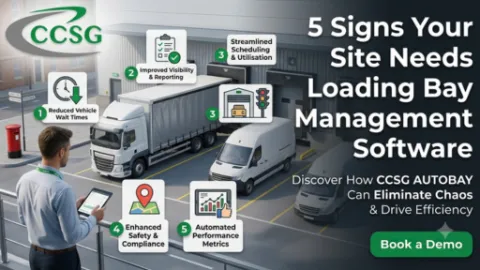
5 Signs Your Site Needs Loading Bay Management Software
Deliveries at your site regularly turn into arguments over who booked a bay first, that is not bad luck. It is a sign your operation has outgrown manual booking. Loading bay management software replaces phone calls and paper logs with a live schedule everyone can see, and most sites consider it only after the daily chaos becomes too costly to ignore.
Here are the five clearest signs it is time to look at a proper loading bay booking system, what to check when you start comparing options, and what it actually costs to wait.
How Do You Know If You Need Loading Bay Management Software?
Quick answer for anyone skimming: the core signs are recurring congestion at peak times, drivers overstaying their slot, deliveries arriving with no booking at all, staff still coordinating by phone or spreadsheet, and no reliable record of who accessed the site. If two or more of these happen weekly, manual management is already costing you more than software would.
These signs rarely appear alone. One problem, like unscheduled deliveries, tends to create a second, like overstays, and the two combine into daily congestion. CCSG's guide to loading bay management software covers the fundamentals in more depth if you want the full picture first.
5 Signs You Need Loading Bay Management Software
Most sites do not experience just one of these problems on its own. They stack, with one issue feeding the next until deliveries feel unmanageable most days of the week.
Sign 1: Warehouse Dock Congestion at Peak Hours
Warehouse dock congestion is usually the first sign anyone notices, since it is the most visible. Multiple drivers arrive within the same window, bays fill up, and vehicles start queuing outside or double parking nearby. This is common wherever several tenants share a small number of bays, especially in retail parks, hospitals, and mixed use residential sites.
Without fixed time slots, congestion repeats every peak period, since nothing spreads arrivals out across the day. Idling vehicles waiting for a bay burn fuel and raise site emissions, and tenants start calling facilities to complain about deliveries running late.
Sign 2: Deliveries Keep Turning Up Unscheduled
If tenants or suppliers arrange their own drop off times without telling facilities, your site has no real booking process, just an informal agreement that breaks down as volume increases. This creates unpredictable clashes and makes bay usage impossible to plan.
A proper dock scheduling software UK setup closes this gap by putting every booking through one shared calendar, so nothing arrives as a surprise. Sites that fix this sign first often see the fastest improvement, since visibility alone removes most of the daily guesswork.
Sign 3: Overstays Are Blocking the Next Booking
One van running 20 minutes over its slot delays every delivery booked after it. Delivery overstays are one of the most common triggers for site-wide delays, and manual systems have no automatic cut off or notification when a slot ends.
The problem compounds through the day. A ten-minute overrun at 9am can push the whole afternoon schedule back by an hour. Software fixes this with a fixed arrival and exit window per booking, plus automated alerts when a vehicle runs late, so staff can act before the delay spreads.
Visit : CCSG retail risk software
Sign 4: Your Team Is Still Running Bookings by Phone or Spreadsheet
If facilities are manually confirming deliveries by phone or a shared spreadsheet, that is a workaround, not a loading bay booking system, and it breaks down fast with staff turnover or a busy morning.
- Bookings get missed or duplicated when two people update the same file at once
- There is no single source of truth for who is arriving when
- New staff spend time learning a process that lives in someone's head, not in a system
- There is no easy way to report on booking volumes or supplier patterns
A digital system removes all of this in one move, since every booking and status update lives in the same platform, visible to the whole team.
READ MORE : What Is Loading Bay Management Software? Does Your Site Need It?
Sign 5: No Audit Trail or Vehicle Security Checks
If an unauthorised vehicle could access your loading bay today and nobody would know, that is a security gap worth taking seriously. Sites without a booking system usually cannot confirm who was on site at a given time, which becomes a problem during disputes or compliance reviews.
Platforms with ANPR integration only grant access to vehicles with a confirmed booking and log every entry and exit automatically, a record that also helps resolve tenant disputes and supplier performance queries.
What Should You Look For in a Loading Bay Booking System?
Not every platform is built for high pressure, multi tenant sites. When comparing options, look for:
- Customisable time slots by bay and vehicle type
- Real time notifications, covering booking confirmations and delivery status
- ANPR integration for pre authorised vehicle access
- Cloud based access from any laptop, tablet, or mobile
- Reporting on users, bookings, suppliers, and a full audit trail
- A short setup window, ideally live within two to three weeks
A system covering all six gives facilities managers both day to day control and the audit history needed for compliance or dispute resolution.
How Does Loading Bay Management Software Solve These Problems?
A dedicated system gives every bay its own calendar, with time slots by vehicle type, automated confirmations, and real time status updates. Drivers book their own slot before leaving the depot, and facilities teams see every arrival in advance instead of finding out on the day.
AUTOBAY, CCSG's platform, is built for multi tenant loading bay software needs across retail, healthcare, residential, commercial, construction, and education sites, with ANPR integration, full audit logging, and reporting by user, booking, and supplier. Most sites go live within 14 days, with one day of on site training, and the platform is cloud hosted and can be whitelabelled to your own domain.
What Happens If You Ignore These Signs?
Sites that leave manual management in place usually see the same five signs get worse, not better, as delivery volumes grow. Congestion spreads into more of the day, overstays become routine rather than occasional, and staff spend a growing share of their week resolving disputes instead of running the site.
The bigger risk is the security gap. Every week without an audit trail is a week where an incident, a dispute, or a compliance check could catch the site with no record to fall back on. Waiting rarely makes the switch easier, it usually just means undoing more informal habits later.
Is Loading Bay Management Software Worth It for Your Site?
If you recognised two or more of the signs above, the short answer is yes. The cost of manual management is not visible on a spreadsheet, it shows up as staff time lost to disputes, tenant complaints, and the occasional security incident that a booking record would have prevented.
Sites that switch tend to notice the change fastest in three areas: fewer arrival disputes, shorter queues at peak times, and less staff time spent chasing down who is supposed to be where.
Final Thoughts
Fixing this does not need a long, complicated rollout. A platform like AUTOBAY is built to go live within two weeks, with minimal training, which keeps the gap between spotting the problem and solving it short. Even one or two of the signs above are reason enough to take a proper look now, before congestion, overstays, and security gaps become a daily routine.
You can see how this works in practice on the AUTOBAY platform page, or book a demo directly with CCSG's team to walk through scheduling, notifications, and reporting for a site like yours.
Frequently Asked Questions
Ans: Recurring congestion at peak delivery times, especially on a predictable schedule week after week rather than as a one off.
Ans: Yes. Fixed arrival and exit windows per slot, plus automated alerts, prevent one delivery from blocking the next booking.
Ans: Yes, particularly with ANPR integration, which only allows pre authorised, booked vehicles access and logs every entry automatically.